C 5 9 F 32 For F

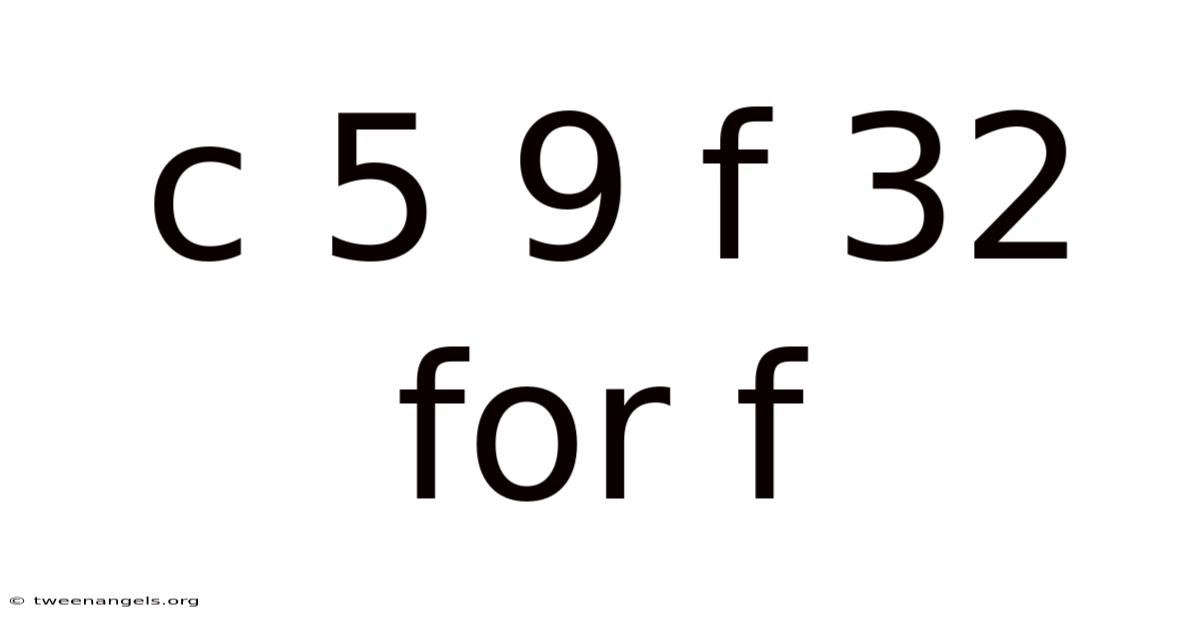
The Celsius to Fahrenheit Conversion: Unlocking the Formula (C × 9/5) + 32
Understanding how to convert temperatures between the Celsius and Fahrenheit scales is a fundamental skill with practical applications in daily life, travel, science, and cooking. While the formula itself—often written as F = (C × 9/5) + 32—appears straightforward, grasping its origin, application, and common pitfalls transforms a simple calculation into a powerful tool for global communication. This guide will demystify the conversion process, providing you with the confidence to move seamlessly between these two dominant temperature scales.
The History Behind the Scales: Why Two Systems?
Before diving into the math, it’s helpful to understand why we have two scales. The Fahrenheit scale, developed by Daniel Gabriel Fahrenheit in 1724, was based on a mixture of ice, water, and salt (0°F) and the average human body temperature (originally 96°F, later standardized to 98.6°F). It became the standard in the United States and a few other countries.
The Celsius scale, created by Anders Celsius in 1742, is logically anchored to the properties of water. It defines 0°C as the freezing point of water and 100°C as the boiling point at standard atmospheric pressure. This intuitive, base-10 system is the global standard for science and is used by virtually every country except the United States, Liberia, and Myanmar.
This historical divergence is the root of our need for conversion. The formula F = (C × 9/5) + 32 is the mathematical bridge connecting these two reference points.
Breaking Down the Formula: A Step-by-Step Guide
The formula F = (C × 9/5) + 32 can be dissected into three clear actions. Let’s use an example: converting 20°C (a pleasant room temperature) to Fahrenheit.
-
Multiply by 9/5 (or 1.8): First, take your Celsius temperature and multiply it by the ratio of the two scales. Why 9/5? Because the Fahrenheit scale has 180 degrees (from 32°F to 212°F) between the freezing and boiling points of water, while the Celsius scale has 100 degrees. The ratio 180/100 simplifies to 9/5 or 1.8.
- Calculation: 20 × (9/5) = 20 × 1.8 = 36.
-
Add 32: This step accounts for the different starting points of the two scales. On the Fahrenheit scale, the freezing point of water is 32°F, not 0°F. Therefore, after scaling the Celsius value to match the Fahrenheit degree size, you must add 32 to align the freezing points.
- Calculation: 36 + 32 = 68.
Result: 20°C is equal to 68°F.
The Reverse Conversion: Fahrenheit to Celsius
To convert from Fahrenheit to Celsius, you simply reverse the operations. The formula is C = (F - 32) × 5/9.
Using our previous result to check:
- Subtract 32: 68 - 32 = 36.
- Multiply by 5/9 (or 0.555...): 36 × (5/9) = 20. We return to our original 20°C, confirming the formulas are inverses of each other.
Practical Examples and Common Applications
Let’s solidify this knowledge with more examples relevant to everyday life.
- Body Temperature: Normal human body temperature is approximately 37°C.
- (37 × 9/5) = 66.6; 66.6 + 32 = 98.6°F.
- Oven Temperature: A recipe calls for 180°C.
- (180 × 9/5) = 324; 324 + 32 = 356°F.
- Weather Report: You hear it’s -5°C in a European city.
- (-5 × 9/5) = -9; -9 + 32 = 23°F.
A Helpful Mnemonic: Many people remember the phrase "Multiply by 9, Divide by 5, Add 32" for Celsius to Fahrenheit. For the reverse, it’s "Subtract 32, Multiply by 5, Divide by 9."
Common Mistakes and How to Avoid Them
Even with a simple formula, errors creep in. Here are the most frequent pitfalls:
- Forgetting the Order of Operations: Always perform the multiplication before the addition. (C × 9/5) + 32 is not the same as C × (9/5 + 32).
- Mishandling Negative Numbers: The formula works perfectly with negative Celsius temperatures (below freezing). The multiplication step will yield a negative number, which you then add 32 to. For example, -10°C: (-10 × 1.8) = -18; -18 + 32 = 14°F.
- Confusing the Formulas: It’s easy to use the Fahrenheit-to-Celsius formula in reverse. A quick mental check: Fahrenheit numbers are generally larger for the same physical temperature (e.g., 100°C is 212°F). If your converted Fahrenheit number is smaller than your Celsius number, you’ve likely used the wrong formula.
- Decimal Point Errors: 9/5 is 1.8. Using 0.9 or 1.09 will throw off your result. It’s often safer to use the fraction (9/5) in calculations to avoid rounding errors until the final step.
The "Why" Behind the 32: A Deeper Look
The addition of 32 is not arbitrary; it’s the offset between the two scales’ zero points. At the exact temperature where water freezes:
- Celsius defines this as **0°
Latest Posts
Latest Posts
-
What Is The Primary Goal Of Financial Management
Mar 28, 2026
-
Which Of The Following Molecules Is Not A Macromolecule
Mar 28, 2026
-
Examples Of Physical Properties And Chemical Properties
Mar 28, 2026
-
Lewis Dot Structure For Phosphorus Pentachloride
Mar 28, 2026
-
Identify The Articulation Site For The Femur
Mar 28, 2026
