7 Protons 8 Neutrons 10 Electrons

tweenangels
Mar 16, 2026 · 8 min read
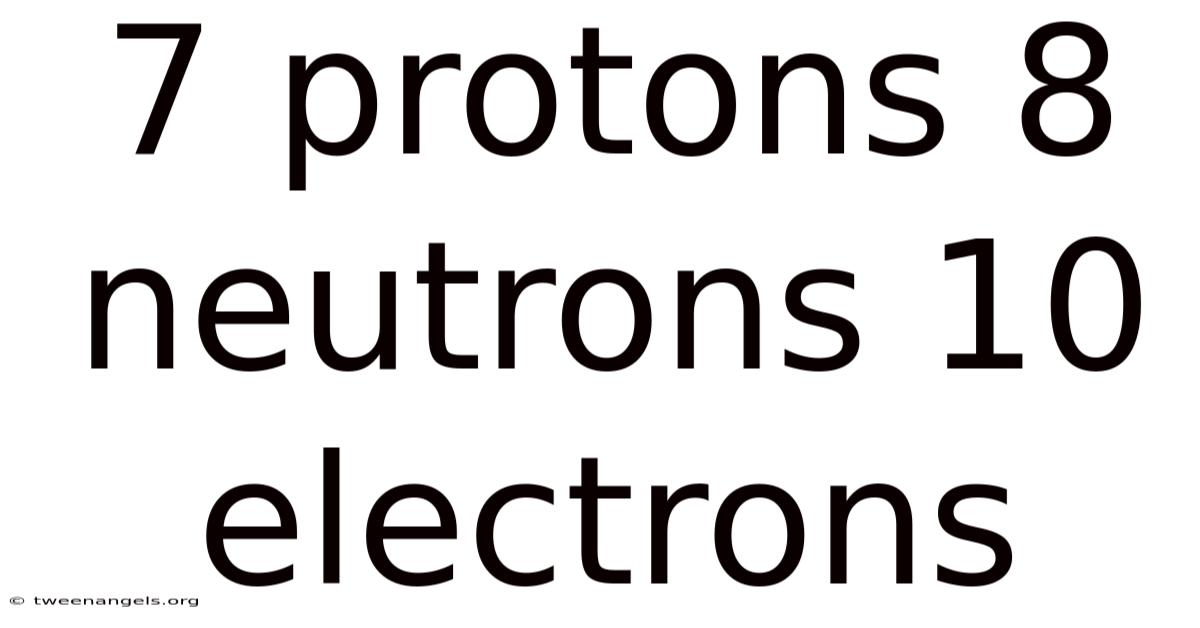
Table of Contents
7 protons 8 neutrons 10 electrons describes a specific atomic species: a nitrogen atom that has gained three extra electrons, giving it a net negative charge. In the language of chemistry this species is the nitride ion, written as N³⁻. Below is an in‑depth look at what this composition means, how it arises, and why it matters in both the laboratory and the natural world.
Introduction: What Does 7 Protons 8 Neutrons 10 Electrons Mean?
When we count the subatomic particles of an atom, the number of protons determines the element, the number of neutrons defines the isotope, and the number of electrons reveals the overall charge.
- 7 protons → atomic number 7 → the element is nitrogen (N).
- 8 neutrons → mass number = protons + neutrons = 7 + 8 = 15, so we are dealing with the isotope nitrogen‑15 (¹⁵N).
- 10 electrons → three more electrons than protons → overall charge = (7 + ) − 10 = −3.
Thus, 7 protons 8 neutrons 10 electrons corresponds to the ¹⁵N³⁻ ion, commonly known as the nitride ion. The following sections break down the science behind this particle, how it forms, and where it appears.
The Building Blocks: Protons, Neutrons, and Electrons
Protons – The Identity Marker
Each proton carries a positive elementary charge (+1 e) and resides in the nucleus. The count of protons is fixed for a given element; changing it would transmute the atom into a different element. For nitrogen, the proton count is always seven.
Neutrons – The Isotopic Variable
Neutrons are neutral particles that also dwell in the nucleus. They contribute to atomic mass but not to charge. Varying the neutron number creates isotopes. Nitrogen has two stable isotopes: ¹⁴N (7 p, 7 n) and ¹⁵N (7 p, 8 n). The ¹⁵N isotope is less abundant (~0.37 % of natural nitrogen) but is invaluable in research because its extra neutron makes it detectable by mass spectrometry and NMR spectroscopy.
Electrons – The Charge Determinant
Electrons orbit the nucleus in energy levels and carry a negative charge (−1 e). In a neutral atom, electron count equals proton count. When electrons are added or removed, the species becomes an ion. Adding three electrons to a nitrogen atom yields N³⁻, the nitride ion.
Formation of the Nitride Ion (N³⁻)
In the LaboratoryNitride ions are rarely found free in solution because they are extremely basic and react vigorously with water. However, they can be generated indirectly:
-
Thermal Decomposition of Metal Nitrides
Heating compounds such as magnesium nitride (Mg₃N₂) or aluminum nitride (AlN) releases nitride ions that can be trapped in low‑temperature matrices. -
Plasma or Discharge Techniques
Passing an electric current through nitrogen gas at low pressure produces a plasma containing N⁺, N· radicals, and, upon electron capture, N³⁻ species that can be probed by mass spectrometry. -
Reduction of Nitrogen‑Containing Precursors Strong reducing agents (e.g., alkali metals) can convert nitriles or azides into nitride salts under anhydrous conditions.
In Nature
Free nitride ions do not persist in the aqueous environment of Earth’s biosphere because they instantly protonate to form ammonia (NH₃) or ammonium (NH₄⁺). Nevertheless, nitride ligands are essential components of certain metalloenzymes, such as nitrogenase, which catalyzes the biological reduction of N₂ to NH₃. In the active site, a transient nitride intermediate is believed to form during the catalytic cycle.
Chemical Properties of N³⁻
| Property | Description |
|---|---|
| Basicity | Nitride is one of the strongest known bases; it abstracts protons from water, alcohols, and even weak acids. |
| Nucleophilicity | The high electron density makes N³⁻ an excellent nucleophile, capable of attacking electrophilic carbon centers. |
| Redox Behavior | Nitride can be oxidized back to nitrogen gas (N₂) or to various nitrogen oxides, depending on the oxidant. |
| Bonding | In compounds, nitride typically forms triple bonds to metals (M≡N) or single bonds to more electropositive elements (e.g., Li₃N). |
| Stability | Stable only in the absence of protic solvents; solid nitride salts (e.g., Li₃N, Ca₃N₂) are insoluble and thermally robust. |
These characteristics explain why nitride ions are valuable in synthetic inorganic chemistry: they enable the construction of metal‑nitride complexes that model active sites of enzymes and serve as precursors to hard, conductive ceramics like titanium nitride (TiN) and boron nitride (BN).
Applications of Nitride‑Based Materials
1. Hard Coatings and Cutting ToolsTitanium nitride (TiN) and zirconium nitride (ZrN) are deposited via chemical vapor deposition (CVD) or physical vapor deposition (PVD) to create gold‑colored, wear‑resistant layers on drills, milling cutters, and biomedical implants. The nitride ion’s ability to form strong covalent bonds with transition metals underlies these coatings’ durability.
2. Semiconductor and Optoelectronic Devices
Gallium nitride (GaN) and indium nitride (InN) are wide‑bandgap semiconductors used in LEDs, laser diodes, and high‑electron‑mobility transistors (HEMTs). The nitride lattice provides excellent thermal conductivity and resistance to radiation damage, making GaN ideal for power electronics and RF amplifiers.
3. Hydrogen Storage and Energy Conversion
Metal nitrides such as magnesium nitride (Mg₃N₂) can undergo hydrolysis to produce ammonia, a potential hydrogen carrier. Conversely, nitride formation from nitrogen gas can store energy in a reversible fashion, an area of active research for nitrogen‑based energy cycles.
4. Catalysis
Surface nitride layers on catalysts (e.g., nitride‑modified nickel) enhance resistance to sintering and improve selectivity in reactions like ammonia synthesis and hydrogenation. The electron‑rich nitride donates density to adjacent metal atoms, modulating their catalytic properties.
Safety and Handling Considerations
Although the nitride ion itself is not encountered as a free species in everyday settings, the compounds that contain it require careful treatment:
- Moisture Sensitivity: Many nitride salts react violently with water, releasing ammonia gas, which is both toxic and flammable. Handle under inert atmosphere (argon or nitrogen) and use dry glassware.
- Thermal Stability: Some metal
...nitrides decompose explosively when heated, requiring controlled thermal processing.
Proper storage involves sealed, moisture-free containers, often under inert gas, and personal protective equipment (gloves, goggles) is mandatory due to the risk of caustic ammonia release and potential metal dust hazards.
Conclusion
The nitride ion, with its distinctive small size, high charge density, and propensity for strong covalent bonding, occupies a unique niche at the intersection of fundamental inorganic chemistry and advanced materials science. Its inherent reactivity—particularly with protic sources—demands rigorous handling protocols, yet this very reactivity is harnessed to create substances of exceptional hardness, electronic functionality, and catalytic activity. From the ubiquitous gold-colored TiN coatings that extend tool life to the GaN semiconductors powering modern lighting and communications, nitride-based materials have already reshaped multiple industries. Current research into nitrogen cycling for energy storage and nitride catalysts for sustainable chemical processes underscores a growing recognition of nitrides not merely as inert ceramics, but as dynamic participants in future energy and manufacturing ecosystems. Thus, the continued exploration of nitride chemistry represents a compelling balance between managing its intrinsic hazards and unlocking its profound technological promise.
The environmental footprint of nitride production and end‑of‑life management is increasingly scrutinized as nitride‑based technologies scale up. Traditional routes to metal nitrides—such as direct nitridation of metals at high temperature or carbothermal reduction of metal oxides in ammonia—often consume considerable energy and can generate nitrogen oxides as by‑products. Emerging greener syntheses aim to mitigate these impacts:
- Plasma‑assisted nitridation employs low‑temperature nitrogen plasmas, reducing the thermal budget and limiting unwanted side reactions.
- Electrochemical nitride formation leverages renewable electricity to drive N₂ reduction at metal electrodes, offering a pathway to integrate nitride synthesis with intermittent power sources.
- Ammonia‑free precursors, such as metal azides or imido complexes, enable nitride deposition under milder conditions, decreasing the risk of explosive decomposition.
Recycling of nitride components also presents opportunities. Titanium nitride coatings, for instance, can be reclaimed via selective acid leaching that dissolves the underlying substrate while leaving the nitride layer intact for reuse. Similarly, gallium nitride wafers can be chemically etched and regrown, preserving the high‑quality crystal lattice essential for optoelectronic performance. Developing closed‑loop loops that capture ammonia released during hydrolysis of nitrides (e.g., Mg₃N₂) and feed it back into Haber‑Bosch or electrochemical nitrogen reduction cycles further enhances the sustainability of nitrogen‑based energy storage concepts.
From a materials‑design perspective, first‑principles calculations and machine‑learning models are accelerating the discovery of nitrides with targeted properties. High‑throughput screening has identified ternary nitrides (e.g., Sn₃N₄, ZrSi₂N₃) that combine wide band gaps with high thermal conductivity, promising for power‑electronics substrates and UV‑detectors. Machine‑learning‑guided synthesis protocols have already reduced the experimental cycle time for optimizing nitride thin‑film stoichiometry by over 40 %.
Looking ahead, the integration of nitride materials into emerging technologies hinges on balancing performance gains with safety and environmental stewardship. Standardized testing protocols for moisture sensitivity and thermal runaway are needed to facilitate broader industrial adoption. Simultaneously, policy incentives that reward low‑carbon nitride production and recycling infrastructure could shift the market toward greener nitride supply chains.
In summary, the nitride ion’s unique chemical character continues to drive innovation across energy storage, catalysis, and advanced electronics. By coupling its intrinsic reactivity with responsible handling, sustainable synthesis, and circular‑economy strategies, nitride‑based systems can evolve from high‑performance curiosities to cornerstone components of a low‑carbon technological future.
Latest Posts
Latest Posts
-
Business Communication Today 15th Edition Pdf
Mar 16, 2026
-
Some Economists Argue That Early Child Care
Mar 16, 2026
-
Calculus For Business Economics Life Sciences And Social Sciences
Mar 16, 2026
-
How Many Valence Electrons Does Aluminum Have
Mar 16, 2026
-
Find The Slope Of The Line Shown Below
Mar 16, 2026
Related Post
Thank you for visiting our website which covers about 7 Protons 8 Neutrons 10 Electrons . We hope the information provided has been useful to you. Feel free to contact us if you have any questions or need further assistance. See you next time and don't miss to bookmark.
